
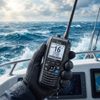
The 3 Best Handheld VHF Marine Radios with GPS for 2026
, by Jesus Moraga, 6 min reading time
, by Jesus Moraga, 6 min reading time
When you're out at sea, a reliable radio can be a matter of life and death. Communication with other vessels and emergency services is nonnegotiable, and radio is not something to cheap out on.
The good news is you don't have to spend a fortune. The best handheld VHF marine radios with GPS offer emergency calling, rugged waterproof construction, and long battery life at accessible prices.
Handheld radios offer superior portability and a great price point, but often, they mean giving up some of the features of a fixed-mount VHF marine radio. That's not true in the case of the Icom M94D.
This is the first handheld radio that allows you to receive information broadcast by other AIS-equipped vessels. It can display vessel traffic information on its built-in screen, and the AIS target call function means you can set up a DSC individual call easily.
Seeing vessel traffic visually is especially valuable in crowded waterways or low visibility.
There’s also a rear panel distress button that you can hit to send a mayday signal if you need to.
The M94D has 6W of transmission power, which gives you a range of 5 to 10 miles out on the water. The 2400 mAh battery provides up to 10 hours of nonstop operation, and the integrated GPS receiver allows you to assign up to 50 different destinations as waypoints.
Of course, this radio is waterproof, rated at IPX7 to withstand submersion in three feet of water for up to 30 minutes. The LCD screen and rear panel distress button will flash when the radio is in the water, making it easy to find. It also has AquaQuake technology to help transmission come through clearly, even when the speaker is waterlogged.
Ultimately, this is the only handheld radio with AIS receive capability in this class, providing advanced features in a small and portable package.
Designed for commercial applications, the Icom M85 is popular with companies and offshore workers thanks to its portability and advanced features. At just 8.6 oz, it's light enough to clip onto clothing and wear all day.
Emergency functions include a Man Overboard alarm, plus Man Down and Lone Worker functions. These allow the radio to automatically send an emergency alarm if it detects a problem.
The radio also has a built-in voice scrambler. It can provide private communication between stations, which can be vital in business operations.
It offers longer battery life than the M94D, with up to 14 hours of operation, and 5W of output. It has the same AquaQuake technology and is rated IP67 for resistance to water and dust. Along with Marine VHF channels, it also covers 136-174 MHz PMR channels, so it can be used for short-range communication on land.
Weighing just 7.7 ounces, the M25 is especially well-suited to recreational boaters, kayakers, and small vessel skippers who want dependable communication without bulk or unnecessary complexity.
It boasts the same Float 'n Flash technology as the M94D. You get around 11 hours of operation on a single charge, with the radio transmitting at 5W.
It has a dedicated weather channel with weather alerts, a favourite channel function, auto scan, and AquaQuake to keep the sound clear even when the speaker is wet.
With big-button controls and Float 'n Flash, the M25 covers the essentials without adding unnecessary weight.
Not all radios have the same features, so it's worth thinking about what you'll use and what you can do without.
Digital Selective Calling is an important safety feature. Basically, it allows you to send a distress signal with the press of a button. Radios with GPS functionality will automatically transmit your location along with the distress alert, making it easier for help to find you.
Some radios have a built-in GPS receiver, while others rely on external devices. The advantages of an internal GPS are:
The sea is hard on just about everything. A good handheld radio should be waterproof, able to float and be submerged, and have easy recovery features so you can find it even during a storm.
Don't overlook a radio's battery life. Consider operating time, standby time, and charging speed when comparing models.
A radio can only help you if it lets you communicate clearly. Look for things like:
Usually not, if you're operating domestically in the United States. But, you may need a license if you:
Note that, unlike VHF channels, PMR channels often require a license to use.
An MMSI is a Maritime Mobile Service Identity.
This nine-digit number identifies your vessel and is used by DSC-equipped radios. It will transmit this number during a distress call so that emergency responders can identify you. Commercial operators often receive an MMSI through the FCC, while recreational boaters can apply for one through FCC or USCG.
Generally, fixed units have higher transmission power and large antennas, giving them greater communication range. They also have permanent power sources so that you don't have to worry about running out of battery.
With that said, a handheld radio can be an excellent backup system, offering portability that a fixed mount radio can't. Sometimes, the best radio is the one you have with you.
The best handheld VHF Marine radio depends on how you use it. Different models have different strengths and weaknesses.
For example, the Icom M25 is a lightweight and dependable choice for recreational boaters, while the M85 gives greater flexibility for mixed marine-land operations. Meanwhile, the M94D offers advanced features like GPS and DSC that make it comparable to a mounted VHF radio, but in a compact, portable package.
Whatever radio you choose, it's one of the smartest safety investments you can make. Check the Icom collection and find the right radio for your next marine voyage.


