
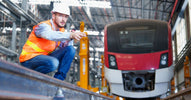
The Role of Hytera Two-Way Radios in Public Transportation
, by Jesus Moraga, 6 min reading time
, by Jesus Moraga, 6 min reading time
Public transportation systems serve as the circulatory system of modern cities. Every day, millions of people rely on buses, trains, trams, and subways to get to work, school, and home. Behind this massive logistical feat lies a complex web of coordination that requires split-second decision-making and seamless information flow. When communication breaks down, schedules slip, and safety risks rise.
Selecting the right communication tools is an investment in continuity and safety. Hytera has emerged as a global leader in this space, providing robust solutions that tackle the unique challenges of the transportation sector. By examining the role of Hytera two-way radios in public transportation, decision-makers across industries—from government agencies and public buses to taxi services and ferries—can understand the gold standard of operational communication.
Fleet vehicles move through dead zones, tunnels, and dense urban canyons. Drivers face constant distractions, and dispatchers must juggle dozens of active channels simultaneously. In this environment, the fragility of cellular networks can become a liability. In an emergency or during a natural disaster, cell towers overload quickly, rendering mobile phones useless when you need them most.
Professional two-way radios provide the dedicated bandwidth and instant push-to-talk (PTT) capabilities that transit operators require. Unlike a phone call, which requires dialing and waiting for a connection, radio communication is immediate. This speed is an operational necessity when a driver needs to report a mechanical failure or a security threat on board.
Public transportation environments are notoriously harsh. Equipment faces exposure to rain, extreme temperatures, dust, and the inevitable drops and knocks of daily use. A device that fails after a minor impact disrupts the workflow and creates a blind spot in the network.
Hytera engineers its radios to meet strict military standards (MIL-STD-810G) for durability. Many models carry high IP ratings, such as IP67 or IP68, meaning they are dust-tight and can withstand submersion in water. For a maintenance crew working on a rainy train trackside or a captain of a ferry dealing with rough waters, this ruggedness ensures reliability.
Furthermore, transit hubs are loud. The screech of brakes, the roar of engines, and the chatter of crowds can make standard audio unintelligible. Hytera addresses this with advanced digital noise-cancellation technology.
Their radios use AI-based algorithms to filter out background noise and amplify the human voice. This allows instructions from dispatch to come through with crystal clarity, preventing miscommunication that could lead to accidents or delays.

Leadership teams within public transportation typically have concerns about transitioning from legacy analog systems to modern digital networks. Ripping out existing infrastructure is costly and disruptive, which is why Hytera offers radios that support "mixed mode" operation. These devices detect signal type, analog or digital, and switch automatically to receive the call. This capability allows organizations to upgrade their fleets gradually.
Digital Mobile Radio (DMR) technology, which Hytera utilizes, also maximizes spectrum efficiency. By using two-slot TDMA (Time Division Multiple Access), Hytera radios double the capacity of a single 12.5 kHz channel. This means large-scale operations like city metro bus systems and taxi services can support more talk groups and more users without paying for additional frequency licenses.
The role of Hytera two-way radios in public transportation extends to safety. Drivers and station staff often work alone or in isolated areas, making them vulnerable in an accident. Hytera integrates sophisticated safety protocols directly into its devices to protect these lone workers. These features are particularly valuable in high-risk environments, where quick response times and accurate location tracking can prevent incidents from escalating.
Sensors inside the radio can detect if a user has fallen or if the device remains motionless for a set period. If the user does not respond to a pre-alert, the radio automatically triggers an emergency alarm to the dispatch center. This "Man Down" feature can save the lives of employees like maintenance engineers and supply chain drivers working in hazardous areas.
Fleet visibility is another requirement of modern transit management. Integrated GPS allows dispatchers to see the exact location of every vehicle and staff member in real time. If a bus deviates from its route, the system can trigger an alert. This precise tracking helps dispatchers drastically reduce response times.
In emergency scenarios, loud radio chatter can escalate a tense situation. A Hytera portable radio supports text messaging and connects seamlessly with Bluetooth earpieces, allowing staff to communicate silently and discreetly. This keeps the public calm while the operations team stays informed.

Operational continuity depends on battery life. A radio that dies 10 hours into a 12-hour shift is a safety liability. Public transport schedules often run around the clock, and constantly swapping batteries is inefficient.
Hytera utilizes the latest lithium-polymer battery technology combined with energy-efficient DMR standards. This results in extended battery life that comfortably covers long shifts. For 24/7 operations, this reliability reduces the logistical headache of managing charging schedules and spare battery inventory.
While the demands of public transportation are unique, the solutions Hytera provides are directly applicable to other sectors, as well. For example, hotels, casinos, property management companies, education, and government agencies all use these tools to coordinate tasks and track employees for safety protocols.
The technology that keeps a city moving is the same technology that can keep your business secure and efficient.
Implementing a communication system requires a partner who understands frequency coordination, system design, and fleet integration. Atlantic Radio Communications has established itself as a leading distributor of two-way radio and GPS fleet tracking products. We don't just sell equipment; we provide solutions.
We serve clients nationwide and ship our products worldwide, ensuring that no matter where you operate, you have access to top-tier Hytera equipment. Contact Atlantic Radio Communications today. Let our experts help you build a communication network that is as reliable, rugged, and efficient as the teams you lead.


