
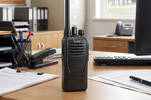
The Three Best Two-Way Radios for Schools
, by Jesus Moraga, 9 min reading time
, by Jesus Moraga, 9 min reading time
A ringing bell doesn't tell you if a hallway is clear, if a visitor needs escorting, or if a student needs help at recess. You rely on two-way radios for instant, reliable communication, whether you're managing the front office, custodial staff, or bus coordination. Below are three radios built for school environments, along with what to look for when choosing a system for your campus.
Every campus has different needs, from a single elementary building to a sprawling high school with multiple entrances. These three radios cover a range of budgets and use cases while holding up to daily school use.
The Icom F1000 and F2000 Analog Portable Radios are a dependable choice for schools that want straightforward, no-frills communication. The F1000 runs on VHF, while the F2000 runs on UHF, so you can choose the band that fits your campus layout. UHF (ultra-high frequency) generally performs better indoors and through walls, making it a strong option for multi-building campuses, while VHF (very high frequency) tends to cover open outdoor spaces more effectively.
Both models carry an IP67 rating, meaning they're fully dust-tight and can withstand submersion in up to one meter of water for 30 minutes. They also meet Mil-STD-810 specifications for shock and vibration resistance, so accidental drops in a busy hallway or on a bus won't take them out of service. With the standard battery, you'll get up to 14 hours of operating time, which covers a full school day with room to spare.
The Hytera BD502i Digital Two-Way Radio is built for schools ready to move to digital communication. It operates on DMR (Digital Mobile Radio) standards, which deliver clearer audio and more efficient use of available channels compared to analog. That clarity matters in gyms, cafeterias, and other noisy environments where a garbled transmission could mean a delayed response.
The BD502i is IP54 rated for dust and water resistance and compliant with MIL-STD-810-G for shock and vibration, standing up to the daily wear of hallway monitoring and outdoor supervision. Its 1,500mAh battery delivers up to 16 hours of talk time in digital mode, and an available 2,000mAh battery extends that to as much as 22 hours. With 48 channels and support for group calls, private calls, and PTT ID, it's a solid fit for coordinating between offices, security, and maintenance staff across a larger campus.
The Motorola CP100d Digital Portable Two-Way Radio is an entry-level option for schools transitioning from analog to digital without a steep learning curve. Built on Motorola's MOTOTRBO platform, it offers up to 4 watts of power on UHF or 5 watts on VHF, with models available in 16-channel, no-display configurations or 160-channel versions with a display and limited keypad.
Digital mode gives the CP100d up to 35% longer talk time than analog and doubles voice capacity on a single licensed channel, so more staff can communicate without needing additional frequencies. It's IP54 rated for dust and water resistance and includes features like Dual Capacity Direct Mode and pre-programmed text messaging, both useful for quick, non-verbal alerts during class changes or events.
Cell phones drop signal in stairwells, go unanswered during class, and depend on networks schools don't control. Two-way radios solve that with instant, one-button communication that reaches an entire team at once, whether that's front office staff, custodians, bus drivers, or recess monitors.
Unlike group texts or phone trees, a two-way radio call goes out immediately and doesn't require the recipient to check a screen. That immediacy is what makes radios the backbone of daily coordination, from managing arrival and dismissal lines to relaying maintenance requests between buildings.
Radios also don't rely on cell towers or Wi-Fi, which means they keep working during network outages, severe weather, or the kind of high-traffic events, like graduation or a school play, that can overwhelm local cell service. For a front office coordinating substitute teachers, a custodian handling a spill between periods, or a bus driver checking in during a field trip, that consistency is what makes radios a daily tool rather than a backup plan.
Group and private calling also let staff route communication appropriately. A general call can alert the whole team to an assembly change, while a private call between the office and a specific staff member keeps a sensitive conversation, like a student pickup issue, off the general channel.
Start by matching a radio's capabilities to your campus.
Coverage for your campus size. A single building has different range needs than a district with multiple schools, parking lots, and athletic fields. UHF handles indoor coverage better, while VHF often performs best across open outdoor terrain.
Audio clarity in noisy environments. Cafeterias, gyms, and hallways during passing periods generate significant background noise. Digital radios, like the Hytera BD502i and Motorola CP100d, are built to cut through that noise more effectively than analog models.
Battery life for a full school day. Staff shouldn't have to worry about a radio dying before dismissal. Look for a minimum of 12-14 hours of operating time, with extended battery options available for longer shifts or after-school events.
Emergency features. Options like emergency alert buttons, private calling, and PTT ID help staff respond quickly and communicate discreetly when a situation calls for it.
Durability. Radios get dropped, rained on, and knocked around in daily use. IP ratings and Mil-STD-810 compliance indicate how well a radio holds up to dust, water, and physical shock.
Ease of use for non-technical staff. Not every staff member using a radio is technically inclined, and simple pre-programmed channels, clear labeling, and minimal setup reduce training time and everyday confusion. This matters most in schools where radios are shared across departments or handed off between shifts. With pre-programmed channels, a substitute teacher or new hire can pick up a radio and start using it immediately, without a walkthrough or training session.
Room to grow. A radio system that only covers the office and custodial staff today may need to expand to cover recess monitors, bus loops, or athletic events next year. Choosing radios with enough channels and repeater compatibility from the start avoids replacing equipment as needs change. A repeater retransmits your signal across a wider area, so you can extend coverage to a stadium, parking lot, or a second building without adding new radios or upgrading your existing units.
Radios play a direct role in how quickly you can respond to an incident. During a lockdown, you need to communicate without relying on an intercom system that broadcasts to the entire building. A private or group call lets you coordinate a response while keeping information limited to those who need it.
During school activities, from assemblies to athletic events, radios help staff manage crowd flow, coordinate parking, and respond to medical or behavioral issues without delay. Visitor access is another area where radios matter: front desk staff can radio ahead to confirm a visitor's identity or flag a concern before that person reaches a classroom, giving security or administrators time to intercept a visitor or restrict access to a specific area.
According to guidance from the Cybersecurity and Infrastructure Security Agency, reliable internal communication is a foundational element of school emergency operations planning, alongside clear protocols and regular staff training. A common radio system setup for larger campuses often includes repeaters to extend coverage across multiple buildings, ensuring no dead zones during a critical moment.
The best options depend on campus size and communication needs. The Icom F1000/F2000, Hytera BD502i, and Motorola CP100d each offer durability, reliable range, and battery life suited to daily school use, from single-building campuses to larger multi-building districts.
Yes. Publicly funded schools are eligible for FCC-licensed business band frequencies, which offer more reliable range than license-free options. Schools that prefer to skip the licensing process can use MURS radios instead. The licensing process typically takes a few weeks, and Atlantic Radio Corp can help you complete the application.
This varies by campus size and staffing. A single elementary school might need a handful of radios for the office, custodial staff, and recess monitors, while a larger campus with multiple buildings, security personnel, and bus operations may need several dozen units across departments. As your program grows, you can add radios in increments and expand channel capacity without replacing your existing system.
Reliable communication keeps a school running smoothly on an ordinary day and keeps everyone safer during an emergency. Whether you need the rugged simplicity of the Icom F1000/F2000, the digital clarity of the Hytera BD502i, or the easy migration path of the Motorola CP100d, choosing radios built for the realities of campus life makes a measurable difference.
For more on building a complete communication plan, see this guide on two-way radios for school safety and emergency response and how two-way radios support campus safety across education settings.


