
How Icom Radios Keep Race Teams Safe and Connected During Events
, by Jesus Moraga, 7 min reading time
, by Jesus Moraga, 7 min reading time
If you're coordinating comms for a race weekend, one dropped call can cost more than a position. From pit lane calls to marshal coordination and medical response, your team depends on radios that work when it matters most. Here's how Icom two-way radios support the communication demands of a race day, from your pit crew to the safety teams working trackside.
A single race weekend brings together dozens of vehicles, hundreds of personnel, and multiple overlapping teams that all need to talk without stepping on each other's signals. You'll typically run race officials, safety crews, spotters, and pit teams on separate channels so that emergency traffic never gets buried under routine chatter.
The physical environment adds another layer of difficulty. Engine noise, crowd noise, and the electrical interference generated by race vehicles can degrade audio quality on standard equipment. Add in long straightaways, elevation changes, and remote sections of track, and coverage becomes as much of a challenge as clarity.
Digital radio technology helps you address the interference problem directly. Digital modes process voice signals differently than analog, which reduces the static and signal degradation that used to be common in high-RF environments like race circuits.
Licensing adds a compliance requirement on top of the technical one. If you're using radios for business or event operations on land mobile frequencies, you generally need frequency coordination and a license under the FCC's Industrial/Business Radio Pool, which is why you'll want to plan channel assignments well before race day.
A race event isn't one communication network. It's several running in parallel, each with its own priorities and its own tolerance for delay.
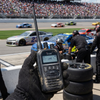
Your pit crew needs instant, clear communication during high-speed stops, where a few seconds of confusion can cost a position or cause an accident. Your crew chief relays tire strategy, fuel calls, and mechanical issues in real time, and portable two-way radios built for high-noise environments cut through both engine noise and crowd noise in the pit lane.
Voice-activated transmission (VOX) matters here too, since it lets your crew members keep their hands free during a stop rather than fumbling for a push-to-talk button.
Your marshals stationed around a circuit or rally course are often the first to spot a hazard, a spin, or debris on track, and they need radios that reach race control without dropping out. Coverage across your full circuit, including remote corners and elevation changes, is a baseline requirement rather than a nice-to-have.
Durability matters just as much as range. Your marshals work outdoors in all conditions, so radios rated for dust and water exposure hold up to rain, mud, and debris kicked up by passing vehicles.
Your medical and safety teams rely on immediate, unambiguous communication to coordinate a response the moment an incident occurs. A dedicated emergency channel, separate from general event traffic, means your safety calls don't get lost behind routine pit or marshal chatter.
Clear audio also helps with early problem detection. If a driver's voice sounds strained, slurred, or slow over the radio, your safety personnel can flag the issue and coordinate medical attention before a situation escalates.
Behind the racing itself, you're coordinating parking, spectator flow, vendor logistics, and security across a large physical footprint. These functions typically run on their own channels so that logistics conversations never interfere with race-critical traffic.
Race environments push equipment hard, and the relevant specs explain why certain radios hold up better than others in this setting.
Water and dust resistance is measured by IP rating, and Icom's motorsport-ready models are built for exactly this kind of exposure. The Icom IC-F52D/F62D Series, for example, carries IP67/66/55/54 protection ratings, meaning it withstands full submersion in water and sustained exposure to dust. That level of protection matters when you're dealing with rain delays, mud, and airborne debris on race day.
Ruggedness goes beyond water and dust. The IC-F52D/F62D Series is also built to survive drops, vibration from vehicle mounts, and the temperature swings you'll face over a full day trackside.
Digital operation is another factor worth understanding. NXDN digital radios process voice signals more efficiently than analog, which improves clarity in high-noise environments and gives you better channel capacity when dozens of users share the same system. The IC-F52D/F62D Series supports both NXDN digital and legacy analog modes, so you have flexibility depending on your existing equipment.
None of this is unique to motorsport. These are the same durability and audio-clarity specs that matter in other demanding outdoor applications for Icom radios, which is exactly why they translate well to your race circuit.
Putting together a communication plan for your race weekend involves more than handing out radios. A few factors determine whether your system actually holds up on event day, and they're the same fundamentals worth checking against any two-way radio you're outfitting your team with.
Walk or map your full circuit, paddock, and spectator areas before the event to identify dead zones, particularly around grandstands, tunnels, or elevation changes that can block signal. You may need a repeater setup for larger venues where handheld range alone won't cover your full footprint.
Assign separate channels to your pit crews, marshals, medical teams, and event management so that emergency traffic isn't competing with routine conversation. Reserve at least one channel exclusively for safety and medical use, and make sure every team lead knows your channel plan before the green flag.
Test every radio, battery, and accessory the day before your event, not the morning of. Confirm that your headsets and earpieces pair correctly with each unit, since a failed accessory connection in the pit lane is a preventable delay.
Race days run long, and a radio that dies mid-shift is a liability for whoever's carrying it. Plan for spare charged batteries or multi-unit charging stations at key locations like race control, the medical tent, and the pit lane.
Confirm which frequencies you're authorized to use well in advance, since business and event radio use on land mobile bands generally requires FCC frequency coordination. Sorting this out weeks ahead helps you avoid last-minute channel conflicts with other users in the area.
The Icom IC-F52D/F62D Series is the strongest fit for motorsport events, giving you rugged, high-IP-rated durability and long battery life across marshal posts, pit lane, and safety team use. If you need something more compact for pit crew handoffs, look for a lightweight model with the same water and dust resistance.
Yes. Icom radios support accessory connectors compatible with headsets and earpieces, so your pit crews and drivers can wear helmet-integrated communication gear. Confirm accessory compatibility with your specific radio model before race day to avoid connection issues.
It depends on the size of your event, but most races need enough radios to cover pit crews, marshals at each corner station, medical and safety personnel, and event management separately. Larger circuits with more marshal posts and support teams require proportionally more units and often a repeater system for full coverage.
Race day communication comes down to a few essentials: reliable coverage across your full venue, radios rugged enough to handle water, dust, and vibration, and a channel plan that keeps emergency traffic separate from routine chatter. Getting these pieces right before the green flag drops is what keeps your pit crews, marshals, and medical teams working together instead of working around communication gaps.
If you're planning communications for an upcoming race event, explore our Icom portable radios built for the durability and clarity these environments demand.


