
What Kind of Two-Way Radios Does the Military Use?
, by Jesus Moraga, 10 min reading time
, by Jesus Moraga, 10 min reading time
Since they were first used in warfare during WWI, two-way radios have become indispensable to militaries across the globe. Even with the emergence of wireless communications like the internet and cellular networks, radios remain the most reliable form of communication for military operations. So, what kind of radios does the military use?
In this guide, we shed light on the main types of military-grade radios and their key features. We also discuss their differences and similarities with civilian-use radios.
Almost all modern militaries rely on the best two-way radio systems to keep critical command and control structures intact and functional. Being able to communicate with personnel and entire units in real-time facilitates informed and efficient decision-making. It also enables soldiers to keep each other and their command units up to date with real-time developments, such as early threats or unexpected obstacles.
Using radio systems, commanders can communicate with disparate teams in far-flung, remote, and rugged areas. When such communications fail, delays, confusion, and mission failures can be consequences.
While radio technology dates back to the mid-19th century, its use became widespread during World War Two, playing a significant role in the transformation of warfare.
Radio systems were heavy and bulky throughout WWII. However, they were portable and allowed near real-time communication between commanders and different units. Commanders could coordinate and communicate with personnel outside of vision, which broadened the scope of employable tactics and allowed for early warnings.
Throughout the wars that engulfed the entire planet, radios were typically short-range only and vulnerable to signal interceptions. Nevertheless, wireless radio communication transformed communication on the battlefield.
Radio technology evolved in leaps and bounds throughout the decades of the Cold War. Radios with newly developed and ever-evolving transistors could achieve longer ranges. Advanced features such as secure voice systems, frequency hopping, and encrypted channels became the norm for militaries such as the United States and Soviet Union.
The Cold War years also saw the boom of space exploration. Radio communication was and still is essential for astronauts to keep in touch with Earth, track rockets, and transmit scientific data.
Today, two-way radios in military settings often utilize satellites as standard. Coupled with other transmitter and repeater systems, satellite-enabled radios enable military units to reliably communicate in real-time from just about anywhere, including most places where cell phones wouldn’t work.
Military two-way radios typically feature software-led designs, integration with IP-based networks and advanced digital encryption. Militaries with secure and reliable global radio communications often have a significant advantage over adversaries.
The most common types of military radio include:
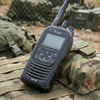
Handheld combat radios: Lightweight and portable, handheld radios allow individual soldiers to communicate with each other within a short range. They’re also designed to be durable, able to withstand the rigors of the battlefield. Typically, handheld radios are used for squad-level coordination during patrols, urban operations, and firefights. Radios like the Motorola R7 are ideal solutions for military use.
Manpack radios: Backpack-style radios are typically more powerful than handheld radios, enabling units to communicate over longer ranges. They’re often used by command units in charge of delegating tactics and keeping field soldiers updated. Many manpack radios feature fold-out antennas and satellite uplink functionality, providing global coverage even in remote and rugged areas.
Vehicle-Mounted Radios: These radios are installed in tanks, command vehicles, armed carriers, and other military vehicles. They tend to be more powerful still than both handheld and manpack radios, capable of keeping mobile units in touch with command centers in rugged, rough, and remote areas.
Airborne Radios: Pilots and air force personnel maintain communications with ground forces and other aircraft by using airborne radios, essential for transport and mission coordination as well as air support and joint operations.
Some of the key features that come as standard with most modern military-grade radios include:
Military radios feature advanced encryption software that uses complex algorithms to scramble messages, ensuring only authorized radio receivers can descramble them. Encrypted communication is essential in preventing adversaries from eavesdropping on tactical communications.
Modern military two-way radios, including the most ‘basic’ handheld systems, automatically alternate between several frequencies per second in sync with authorized, friendly radios. This prevents enemy units from jamming frequencies and disrupting the ability of teams to communicate with each other.
Most military radios can utilize every band on the radio communications spectrum. This gives soldiers access to standard VHF (very high frequency) and UHF (ultra-high frequency) channels as well as HF (high frequency) channels that can transmit communications across entire continents. Many radios also feature SATCOM, allowing them to communicate globally using satellites.
Military radios can withstand extremely tough conditions. Designed to impeccably high military standards, these radios are virtually impervious to threats like water immersion, electric surges, heavy impacts, vibrations, plus heat, cold, and dust. The Icom F4400D is a fantastic example of a military radio capable of withstanding the wear and tear of use.
Nowadays, military radios can do much more than just transmit audio signals over the air waves. They can also transmit digital data, such as text messages, GPS coordinates, imagery, sensor data, and more. This is one example of a technological advancement that you can now find on many civilian radios as well.
As technology and warfare continue to evolve in leaps and bounds, armed forces require radios that are versatile enough to keep up with ever-changing requirements without needing replacements. Most modern military radios feature programmable software, which means they can be updated with new missions and encryption frequencies using the same hardware.
Nowadays, many features that were once exclusive to military two-way radios are becoming increasingly common features of civilian-use radios. For example, common overlapping features of high-quality radios include IP network connectivity, frequency and channel assignment automation, advanced calling features, data integration, and GPS functionality. Many radios designed for commercial purposes also feature encryption to ensure private communication.
However, the software utilized by military radios is far more advanced than standard civilian radio tech, with more complex scrambling and encryption plus features such as rapid frequency hopping. Moreover, military radios are built to much higher specifications than civilian and commercial radios, able to withstand the harsh conditions of all types of battlefield.
While many modern civilian radios are durable, they don’t put as stiff resistance to dust, water immersion, impacts, and general wear-and-tear as military-grade systems. Still, if you familiarize yourself with the best practices of radio equipment, you can potentially extend the lifespan of your system by several years.
As mentioned above, modern civilian-use two-way radios have many features in common with military-grade radios, such as secure encryption, GPS tracking, and digital integration. As such, these radios that share many similarities with military radios are common in industries such as:
Two-way radios are essential items of equipment for police and fire departments as well as paramedics. Radios are used to coordinate missions, update personnel in real-time, and dispatch mobile units. Similar to military radios, radios used by the emergency services tend to feature advanced encryption to prevent interference and protect sensitive information.
Just as the air force uses two-way radios so that pilots can communicate with other pilots and ground forces in real-time, air traffic controllers and commercial pilots rely on radios for ground-to-air and air-to-air communication.
High frequency radios like those in military use are common in the maritime industry. Shipping crews depend on radios to maintain communications with shore-based personnel and command structures. Often, like military radios, commercial maritime radios can utilize satellites to communicate globally with minimal risk of interference or disruptions.
Industrial settings, particularly hazardous ones, often use extremely rugged radios similar to those of the military. Digital radios with features like GPS tracking and telemetry, which are typical of military radios, are becoming increasingly common in heavy industrial settings, where instant communication is paramount to safety and efficiency.
Military radios tend to be more technologically advanced than civilian radios, although features once reserved for military use are becoming increasingly common standard features of civilian radios, such as GPS tracking and encryption. However, military radios are typically built to higher design specifications than civilian counterparts, ensuring they can withstand the rigors of the battlefield.
There’s virtually no limit to the range of military radios, depending on the type, hardware, and software. For example, handheld radios designed with portability in mind may have a range of just a few miles, while vehicle-mounted radios with satellite uplink capability can have a global range.
Most commercial settings don’t need the ruggedized radios of the military that can survive heavy impacts and complete water immersion. However, features like digital data transmission, GPS tracking, and background noise filtering can come in particularly useful.
Fortunately, such specifications are becoming increasingly common features of civilian radios. Take a look at the latest range of radios from esteemed brands like Motorola and Hytera at Atlantic Radio Corp.


